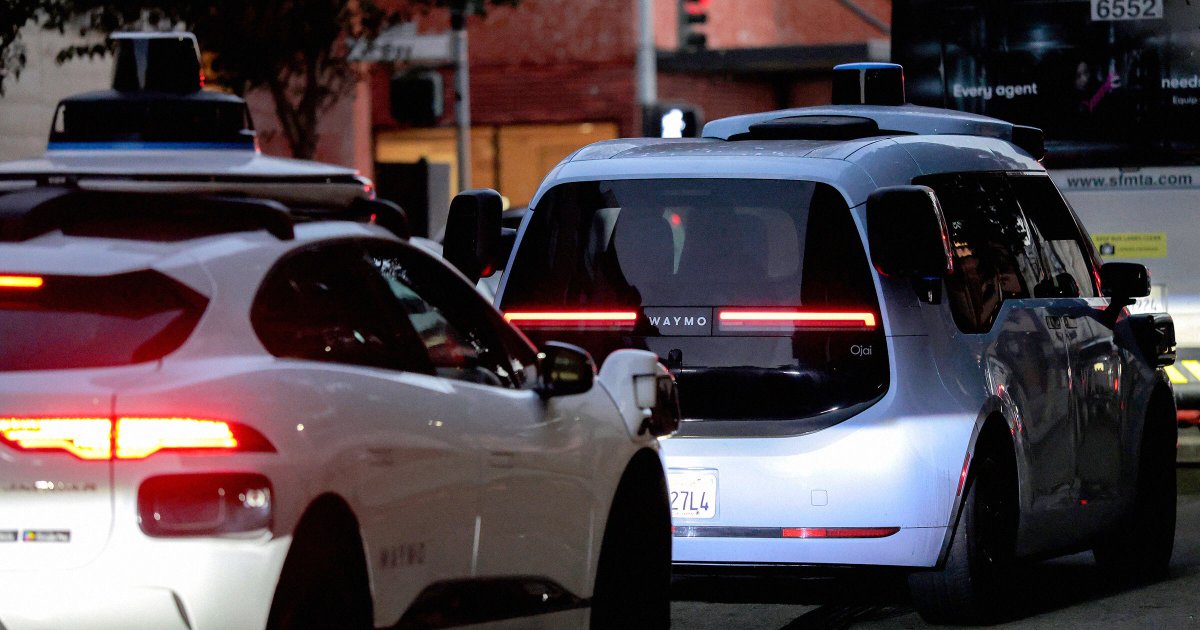
This shouldn’t be a surprise. Both Uber and Lyft have had it on their website for years that their intention was to eventually have a driverless fleet.
Rideshare driving has been a great thing for people who have been unemployed or underemployed. It has helped keep MAGA afloat. Without rideshare jobs, the unemployment stats would be far worse, and we would have a LOT more people on the edge, or even homeless.
Perhaps we should limit the percentage of driverless vehicles that these fleets contain.
Yes, that was the plan all along. Uber intended to be a robotaxi company, but self-driving car technology was not ready. They launched with human drivers to build up market share. The plan was always to funnel profits from ride-shares into self-driving cars and then start replacing human driven cars with robots, where it would be profitable.
Enshittification in a nutshell.
Uber spent a decade telling cities that protecting taxi drivers was anti innovation. Now that robotaxis threaten its own business, suddenly limits on new competitors sound reasonable. Amazing how quickly »disruption« becomes »regulation« when the disruption reaches the boardroom.
»disruption«
What’s with the weird syntax. Is this AI bot having a stroke?
It’s not »weird«, it’s beautiful.
Gotta hide em dashes somehow I guess
So much regulation can sadly be boiled down to the idea “Contempt of Business Model.” Because once that business is entrenched and can afford lobbyists, now it’s time to lobby anything other than their business model as illegal.
Uber spent a decade telling cities that protecting taxi drivers was anti innovation. Now that robotaxis threaten its own business, suddenly limits on new competitors sound reasonable.
Uber has also been working on and I’m pretty sure has been operating robotaxis.
My impression is that human drivers were probably going to be a temporary situation for them as they built out their system, which would provide a strategically-advantageous position relative to competing robotaxi operators for them to do the transition to robotaxis.
searches
https://en.wikipedia.org/wiki/Uber
The company has launched or is in the process of launching robotaxi services in several cities worldwide in partnership with operators, software designers, and car manufacturers including Lucid Motors, Nuro, Baidu, Pony.ai, Avride, Nissan, Rivian, Zoox, Stellantis, Wayve, and Nvidia (to use the Nvidia Drive software).[3][4][5][6]
If you’re in an area served by Fare… https://www.fare.coop/
Honestly the sooner we have fully autonomous cars the better. This growing pain in the worst part but think about things
- The ability to watch TV, eat, read, nap, work in your car if you want while it drives you places
- a safer experience due to faster reaction times
- less traffic jams and slow downs due to more coordinated timing
- better independence for the infirm and elderly (this is one I think a lot of people overlook)
Too many people are still scared at this point but overall this would be a positive step for societies. I know there are negatives (car could repossess itself or it could cart me off to jail) but we can’t always fall in the trap of “it has to be 100% right”.
Or maybe we could put all that effort into public transit? I lived in Germany for a few years. I did have a car, but I rarely ever used it. I could take a bus to most places in town, including the train station. Most downtown areas were pedestrian traffic only and it was very nice. Now that I live back in the US, I spend so much time in traffic. Their is always construction to make the roads bigger for all the cars. But it never seems to be enough. The whole thing feels like an expensive mess. I don’t think self-driving cars will fix enough of the problems with cars.
Why stop dreaming there? We could have functional transit and citie streets you could walk and play in if the cars weren’t there.
Yeah it’s called a rail. We inexplicably paved over them in the 60’s.
I get a glimpse of what once was every time they tear open the road. :(
Yeah, and with the state of cybersecurity, we can regularly experience the beginning of that movie Upgrade!
The entire rhetoric relies on the idea that self driving road cars are
- Feasible
- Desirable over rail or bus
Tesla’s failed efforts have proven time and time again that the road is full of unexpected and arbitrary inaccuracies, ambiguities and risks that cannot be assessed by a machine alone. They’ve also been sued in multiple markets on claims of false advertising because autopilot is not, in fact, autopilot.
They don’t even have the best system in the industry, that would be Drive Pilot, a Level 3 autonomous assist system by Mercedes-Benz. The only systems to have level 4 are taxis that only operate in limited areas, on limited, known routes, and they are well known for being very easily confused and blocking emergency vehicles.
The only systems to have level 4 are taxis that only operate in limited areas, on limited, known routes, and they are well known for being very easily confused and blocking emergency vehicles.
Even then, they have overrides for human operators when they fuck up. Driverless cars, my ass.
Tesla is far from the only player - they’re just the loudest, and sadly the most embarrassing. Waymo and Zoox, for example, are demonstrating its real feasibility and desirability.
To be fair, I’ve never stepped into a Waymo, but from what I’ve heard they’re sent on pre-determined paths around a delimited area. These only seem to be feasible you can either strictly control your environment or adjust for a finite number of cases, such as a delimited area, and even that isn’t working too hot for other road users.
I still don’t see the advantage versus a taxi bus.
The “delimited area” comprises entire cities, and they are not following predetermined paths, except in the sense that they only follow mapped roads. And the entire point is to share the road with human drivers.
Taxi buses do not operate on-demand.
As someone who deals with IT and cybersecurity (and traffic) as part of my daily job, I will happily sit in traffic to actually own and have control over my vehicle.
Not worth the instability on society from the job loss. Also claims like faster traction times are questionable.
Personally, I don’t want a computer making life or death decisions in the heat of the moment
Autonomous cars sound cool in theory, but I’m a techbro-phobe.
In this case, the advantage is that autonomous vehicles have the real possibility to be significantly safer than human drivers (with some obvious exceptions - looking at you, Tesla).
I remember watching a video showing how increased reaction speed can virtually eliminate traffic jams (I believe it was this one?). It’d require nearly all vehicles to be automated, but someday city traffic might flow smoothly even during the busiest of rush hours.
Anything but trains
Many cities have public transit in the form of busses and/or subway systems, but regular street traffic still exists and car ownership has so much cultural inertia that it’ll probably take decades to wean people off of them.
However, that doesn’t mean we should refuse to improve cars in the meantime just because they’re not the transport solution we’d prefer.
I understand that. I just found it houmous how similar self-driving cars all diving at a set speed to “eliminate traffic” would be to trains.
I keep forgetting that trains stop in front of every building!
I’m sure self-driving cars stopping in front of every building would solve traffic. /s
Last-mile runs to and from transit stations would.
God forbid having to walk five minutes from the bus stop or train station
Good thing disabled people don’t exist
I must admit you are right because all people driving cars are disabled people, public transportation adapted for disabled people doesn’t exist, neither mobility aids.
And exceptions for cars used by disabled people doesn’t exist either.
/s
Get real.
Paratransit is excruciatingly slow and unreliable. Mobility aids don’t elevate everyone to the same level as the most able-bodied.
On another note, you’re also ignoring poor transit service in suburban and rural areas.
That might be true but only if there is fewer humans at some point.
You can’t just keep widening roads. There are 50 percent more humans in my city then 25 years ago. If you reduce traffic more people will buy cars.
So at some point something has to give.
deleted by creator